
CRISTIAN MORELLI
1. From local – the rise of the Gulf States into space international competition
Since their economic rise in the second half of the 20th century, Gulf States have demonstrated to know how to invest efficiently their enormous wealth. From infrastructures to tourism, and from culture to sports, they have transformed the Arabian Peninsula into a futuristic hub for investments, including space.
Thanks to their economic power, Gulf States had the possibility to take the leading role in the MENA region regarding the space sector, as it requires large quantities of liquidity, know-how, and tech hubs. Higher shares of national GDP devolved to R&D and specific budget allocation to their respective national space agencies and programs, allow Gulf States to outclass other competitors in the run to regional leadership in the conquering of space. Saudi Arabia and the United Arab Emirates (UAE) can be indicated as the most active countries in the sector, due to their higher contribution to scientific research, space technology developments, and direct participation in space scientific missions and explorations[ii].
The first achievement in the space field, was accomplished by the Arab League’s satellite company (Arabsat) with the sending into orbit of the first Arab satellite in 1985. In order to escape from uneven local competition across Arab States, and under the leadership of the UAE, the Arab Space Cooperation Group (ASCG) was created. Since 2019, this Group increased in number of participating States and now comprises 14 countries of the MENA region – Algeria, Bahrain, Egypt, Iraq, Jordan, Kuwait, Lebanon, Mauritania, Morocco, Oman, Saudi Arabia, Sudan, Tunisia, and the UAE. Its purpose is to enhance cooperation among Arab States for the promotion of scientific research and peaceful exploration of space[iii].
2. To global – where do Gulf States stand compared to space powers
Although Saudi Arabia’s and UAE’s space programs are competing against each other in the attempt to become the region’s leader, and despite their relatively small budgets for their respective space programs – Saudi Arabia ($2.1 billion, as outlined in the Saudi Vision 2030) and UAE ($800 million, as determined by the 2021 National Space Fund), both countries were able to accomplish significant achievements in a relatively small amount of time compared to more advanced and more expert counterparts around the globe.
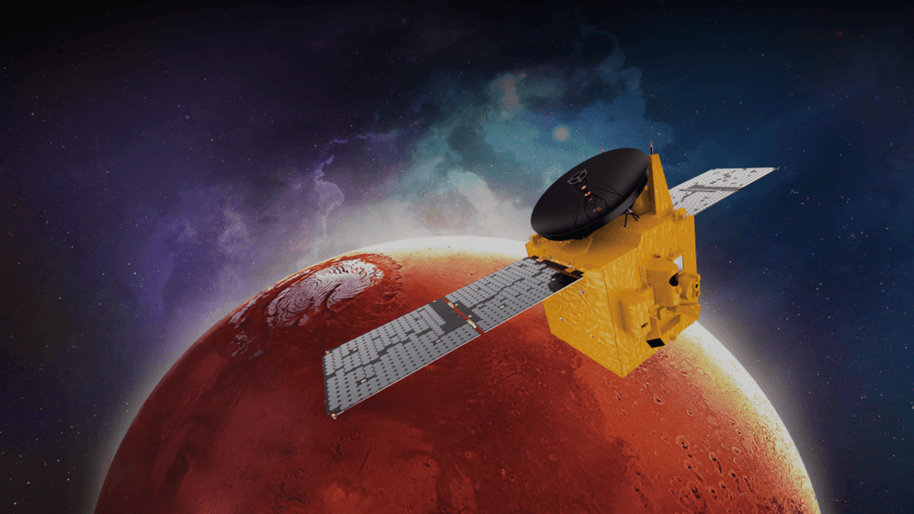
In fact, we can consider the participation of two Saudi astronauts on board of the International Space Station (ISS) in 2023 and the UAE’s Hope Probe who reached Mars’ orbit in 2021 making the Gulf Emirate the first Arab country (and the fifth overall) to ever accomplish such a task. Surely such achievements allow the two countries to be defined as the region’s powerhouses. In order to set a clearer definition on how to rank the two countries analyzed, we can consider the total budget spent on civil space programs. By considering the 2021 budget allocations, only Saudi Arabia would be inserted in the top 10 space powers, with the USA and China at the lead (respectively with more than $54 billion and more than $10 billion). In specific, Saudi Arabia would be positioned in 7th place, between Germany and India – 8th if we also consider the EU. If taken collectively, the Arab States composing the ASCG would surely be ranked higher by summing the national budgets of their respective space programs[iv].
However, to classify Arab countries among space powerhouses is still not possible. Budget comparison is only a simplistic way to determine whether a country can be classified as a space power. In order to be classified as such, a country should also demonstrate the willingness to participate in knowledge sharing, increase the number of successful scientific space missions, increase partnerships with the private sector, and engage in more international missions.
3. What future role for the Gulf States in the conquering of space
Since ASCG MS have only recently joined the race to space by adopting large $multi-million national programs, one of their biggest challenges – and similarly to their more experienced counterparts – will be the internal competition between civil public-funded programs and private-funded programs, or in other words, the commercialization of space. PWC believes that by 2030, the global total expenditure for space programs will increase up to $1 trillion (a surge of more than 180% compared to 2020) due also to the large private investments made for non-scientific purposes such as tourism and, most importantly, defense technologies[v].
Space tourism triggers the imagination of many. Recent space travels made by billionaires Jeff Bezos and Richard Branson paved the way to the future of tourism around, or even outside, earth’s orbit. Space tourism business is still young and not established enough to guarantee competitive prices to the many human beings who have always dreamed of being an astronaut for a day. It is, however, affordable to the many billionaires and millionaires living in the Gulf region. It is plausible to consider that this region will become the hub with the highest concentration of space tourists and private businesses granting such commodity[vi].
Defense technologies in space are of major importance to the Arab world. As the majority of the Muslim world (Sunni) is slowly improving its diplomatic and economic ties with Israel, the major regional threat is now posed by Iran. In recent years, Iran has significantly improved its ballistic vectors. Gulf States, in particular, who do not host large armies and military capabilities, require greater involvement of the private sector in the development of ballistic vectors and monitoring satellites for defense purposes[vii].
Lastly, Arab-led space exploration has just begun. The UAE’s impressive ambitions of sending an Emirati-produced rover for the exploration of uncharted sections of the moon by 2024, and to begin an interplanetary mission by 2028, are setting the Region’s standards for other Arab countries to emulate[viii].
The sustained and rapid growth in the MENA region’s participation in space competition should not be considered as a surprise. Their capabilities to quickly achieve significant accomplishments allow them to considerably decrease their gap from major space powers in relatively short periods of time. However, it is still difficult to determine their ranking with established powerhouses as they are still rather too ‘young’ to be compared with more expert countries.
In a more polarized world, Arab regional cooperation can become an example of renewed interest and willingness for international cooperation. The de-orbitation of the ISS by the end of the decade will mark the end of an era. New powerhouses are on the rise. Healthy competition, based on knowledge- and technology-sharing, by also including Arab countries’ liquidity and expertise in the realization of a new era of space international cooperation, will change space exploration for generations.
[i] Foto: UAE Space Agency, An artist’s rendition of the Hope orbiter around Mars., in The UAE’s Hope probe has successfully arrived in orbit around Mars by Neel V. Patel
[ii] “Arab Space Programs Level Up”, in Arab Center Washington DC, April 30 2021, last access July 4 2023, LINK.
[iii] “The Gulf States Plan to Conquer Space”, in Le Monde, June 27 2023, last access on July 5 2023, LINK.
[iv] “Government Expenditure on space programs in 2020 and 2022, in major countries (in billion U.S. dollars)”, in Statista, February 6 2023, last access on July 4 2023, LINK.
[v] “How the Arab world is fueling global space exploration efforts”, in Wired, May 1 2023, last access on July 4 2023, LINK.
[vi] “The Future of Space Tourism Is Now. Well, Not Quite”, in The New York Times, May 7 2022, last access on July 5 2023, LINK.
[vii] “Readout of the New Round of U.S. – Gulf Cooperation Council Working Groups on Integrated Air and Missile Defense and Maritime Security”, in U.S. Department of Defense, February 14 2023, last access on July 4 2023, LINK.
 Limes Club Firenze
Lascia un commento