
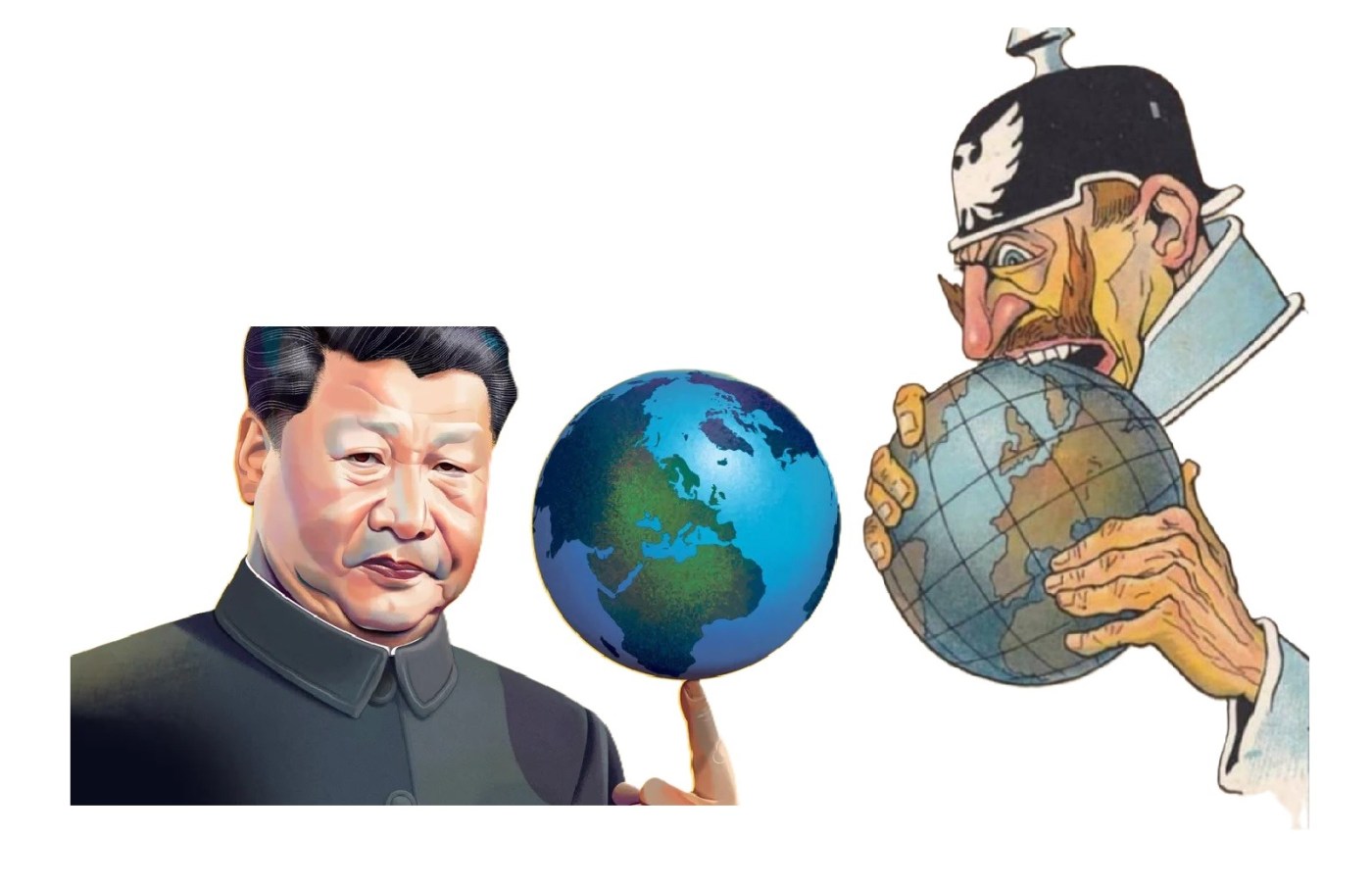
ANDREA PERRINO | When we look at the evolution of Modern China in international relations (IR), it comes easy to find analogies with the German Second Reich of the late 19th and early 20th centuries. The China I am referring to is the one whose evolution can be split under two historical moments, belonging to the different mark of two leaders: Deng Xiaoping, who reinvented China as the “factory of the world”, and Xi Jinping with his nationalist and militaristic turn.
The relay between these two Chinese leaders perfectly resembles the precedent of Germany, which went from the pragmatic leadership of Bismark to the ideological and aggressive boost of Kaiser Wilhelm II.
The intellectual curiosity which today prompts many IR scholars to make comparisons between these two rising nations is partly due to some natural similarities, but also derives from the temptation to respond to the uncertainties of a once-again multipolar and unpredictable world by recalling the disastrous fate of the system of the beginning of the 20th century, in which Wilhelm II marched Europe over the precipice of WWI in 1914[1], entailing a disturbing question: can today’s Chinese ambitions and erratic behavior lead the world into the same conflagration?
To give substance to the analogy hypothesis, I will take up the historiographical theory of “Sonderweg” (special way): the post-war expression that indicates the deviation made by Germany in the historical path that led Western countries to liberal parliamentary democracy. Although this term is debated – since it has been inter alias used to theologically interpret modern German history sub specie 1933[2].
Sonderweg as the Chinese special way: the deviation made by China in the historical path that former socialist and third world countries were supposed to follow post-1989 toward liberal parliamentary democracy, according to the “End-of-history” theory[3].
I argue that both the German and Chinese special ways have been possible for – similar – structural patterns (the “deep forces”[4]) and the analogue political strategy of their leaderships.
Among the relevant and common “deep forces” that can be attributed to modern China and the German Second Empire, the national unification/ independence has been achieved later compared to the other powers (Die verspätete Nation-en)[5], as well as industrialization and economic growth – the latter in a fast and impressive fashion -. Both countries share the patterns of aggressive rising powers, with a growing export competing with that of the biggest economic powers of their international systems – in turn Great Britain and the US -. In both cases, this fast growth worried neighbors and the older “great powers” already on stage[6].
These structural characteristics remain not enough to explain the Sonderweg thesis of Germany and Modern China, which has to do with the hybrid and paradox domestic and foreign politics of these countries, shaped in major part by the hands of their leaders: Bismark and Deng Xiaoping.
To understand the extent of the relevance of such leaders for their countries’ future, I offer the example of the German unification in 1871, which was not granted as an inescapable historical destiny worthy of the last stage of the Hegelian spirit: the conservative princes of Bavaria would have preferred maintaining a German confederation instead of a unified state, yet it was Bismark’s ability to exploit historical contingencies, the so-called “art of the possible”, that led the Prussian statesman to unleash the decisive Austro-Prussian war of 1866 and the Franco-Prussian War of 1970, in both cases searching for the improbable domestic consensus of the liberals – Bismark’s ideological adversaries – , in order to present a “cabinet war” as “national war”.
Deng Xiaoping, despite not being China’s paterpatriae, exploited the “art of the possible” to carry out those economic reforms that turned China into the new factory of the world. Napoleon’s famous saying became reality -“China is a sleeping giant, when she wakes, she will shake the world“- but not for the power of a self-fulfilling prophecy, yet for the playful foresight of Deng Xiaoping.
GERMAN AND CHINESE SONDERWEG IN POLITICS
“Kanzlersmonarchie vis-à-vis a Democratic Dictatorship”
The ”liberal thesis of the Sonderweg” stresses the non-parliamentary character of the German monarchy, while all the other European national revolutions led to the victory of liberalism and constitutionalism[7]. It seems a paradox that Bismark had introduced the direct universal voting rights, but the only reason was that of steering the masses to weaken the liberals. “I consider direct elections and universal voting rights to be a great guarantee for a conservative attitude”. The democratic parliament had actually few substantive powers, while the Kaiser was paramount and the kanzler’s prerogatives surpassed those of any other european premier: being defined by its two most important elements, this political system has been called Kanzlersmonarchie[8].
After Mao’s death, Deng Xiaoping made new reforms kicking-off a revolution, yet of a conservative sign, similarly to Bismark’s: in august 1980 new constitutional terms limits were set for state officials and withing the third Chinese constitution even the president could not serve more than two consecutive terms. In any case, the Communist Party remained the only-party, and the moderation of Chinese politics was not followed by democratization. Deng remained in full control[9], aiming to avoid the degeneration of the system of power as it had already occurred regarding to the collapse of the Soviet Union, and when people asked for political reforms, he did not mind using repression as in Tiananmen Square in 1989.
GERMAN WAY AND CHINESE WAY: THE SOCIETY.
Deng understood people’s desire for material well-being and progress, but to achieve this aim he became aware of the necessity of steering away from collectivist measures and embracing open-ups towards the liberal market: the utmost example of this policy was the creation of the Special Economic Zones (ZES), that also led to a change of the Chinese society which started to run at different speeds. Certainly, this required a doctrinal stunt, that Deng performed with a Bismark-worth realpolitik: his most famous sentence is “It doesn’t matter whether a cat is black or white, as long as it catches mice”. However, this did not correspond to a liberalization of the political freedoms: Deng was able to reconcile his sympathy for people’s welfare with his posture of toughness: a system defined as “authoritarianism tempered with anarchy”[10].
This weird mix of economic liberalism and authoritarianism is a déjà vu of the bismarkian society: the Keiserreich enabled a degree of liberality in the fields of law, press, theatre, with a bourgeois hegemony in the economic, social and cultural life of the Empire. At the same time, the middle class was not able to affirm itself in the politics, where the élites remained the Junker, the agrarian landowners[11].
GEOPOLITICAL THESIS OF SONDERWEG
“Mittelage vis-à-vis Zhongguo[12]”
The geopolitical version of the Sonderweg poses that the geographical position of Germany in the middle of Europe could influence its foreign policy’s Eigenweg[13]. The birth of Germany destabilized by its own the balanced system of Vienna (1815), that relied on a European system a predominance of “lateral (or wing) powers” (Russia and Great Britain) over the “central ones” (a Germanic fragmented confederation with an Austrian hegemony). The unification of Germany in 1871 reversed this relationship and made Germany the gravitational center of Europe, owning the geographical “Mittelage” (middle position) of the continent, thus undermining the Vienna’s principle of equilibrium[14]. Yet, Bismarck was deeply conservative – Kissinger defined him “The White Revolutionary” – and tried to dissimulate the truly German power, not to worry other neighbors[15]. He succeeded during the Berlin Congress of 1878, when he presented himself as a “honest broker” (ehrlicher Makler), and Germany as a “saturierte Macht”: a nation with no other territorial claims. From that moment on, thanks to his diplomatic skill as a weaver of relations (bindungsfähigkeit)[16], Bismark began to build a network of allies although Germany could have acted as a solitary hegemon: here is why the Second Reich has been defined as a semi-hegemony.
The rise of Modern China in the International relations follows a similar path of that of the Second German Empire: in Chinese, China means “State in the Middle”, Zhongguo 中国, and after the “century of humiliation”, the Chinese leadership understood that only by becoming a strong power, China could have avoided being subjugated to external forces. It would have been possible to do so either by military strength or by economic means (as for Germany). Deng Xiaoping managed with realpolitik to insert his country within a monopolar system dominated by the United States, after creating a network of international allies (the traditional Chinese concept of Guanxi 关系)[17], so that even Clinton’s economic advisor Larry Summer advocated for China’s entrance in WTO. Deng knew he didn’t have to provoke the Western giant: “Hide your strength, bide your time”, recalling the concept of semi-hegemony of the Bismarckian Reich.
FROM THE SONDERWEG TO THE MILITARIST TURN
Under Bismark and Deng, the two countries shared unique yet successful systems, whereby the unbridgeable social and geopolitical contradictions of such systems did not survive their creators and exploded as soon as they left the scene. Soon after, the new leaders would resolve these differences by focusing on nationalism, a more aggressive posture and global demands:
Kaiser Wilhelm II centralized all power in his hands, promoting an aggressive “Weltpolitik” and building a fleet that put Berlin fatally in collision with London, while Xi Jinping increased his political power (with an inedited third term) and branded a Chinese weltpolitik whose key project is the Belt and Road initiative[18].
Xi Jinping, as von Tirpitz[19], is establishing China as a naval power with the nationalistic goal of revisionism in the South China Sea, through the U-shaped eleven-dash line project. Other puzzling policies of this category are that aiming at virilization and militarization of the masses called “xiao xian rou”[20], the aggressive “Wolf Warrior Diplomacy”[21], and in particular the clash with the US over Taiwan, forerunner of the Thucydides trap.
WHAT HISTORICAL LESSON DO WE LEARN?
“Que demander à l’histoire?” wondered the famous historian March Bloch[22]. The analogies suggested between the German and Chinese Sonderweg do not imply that the new Beijing stand will drag Washington into a war. However, history is “une science de l’homme”[23], and it helps forming categories to better understand the present: where the international system has once-again become multipolar, but has extended from a handful of western countries till to embrace the whole world, especially after the decolonization and the fall of the soviet bloc. And it is to the Global South that China is addressing the Beijing Consensus’, reiterated in its “12-point peace plan for the Ukraine”, which allows China to reclaim a universal ideology to become a superpower. The Second Reich had not such a global ideology, nor was it a superpower. However, the questions still left open about the links between Germany and the WWI are valid also for nowadays’ China and international arena, and reflecting on one is equivalent to understanding the other. Why is the Bismarkian system degenerated in the Wihlelmine one? Did it occur for the insurmountable contradictions of its Sonderweg? When yes, also China should beware of a likely implosion (be it economic, social, or even political) of its system. According to Kissinger, the issue with the Bismarkian system is that it was genial, but too complex to survive to other leaders not up to Bismarck[24]. Is this the case of the post-Deng China? Another critic expressed by Kissinger on Bismark is that the Kanzler always reasoned in European terms, although Germany should have assumed the lead in global terms. In other words, since the German power was already outstanding, it would have been clever to overcome the low-profile semi-hegemony, to embrace the true responsibilities, and scale, of a hegemonic country. Wilhelm II acted too late and clumsy. Can this critic be addressed also to Deng Xiaoping?
In the end, even the Kriegsschuldfrage (war guilt) is not totally to be shouldered over Germany. In the masterpiece “Perception and Misperception in International Politics”, Robert Jerwis discusses the role of actor’s understanding in IR: was the German aggressive behavior “influenced by optimism in the own’s means or by a sense of menace and decline?”[25]. He also points out that “British leaders had exaggerated the threat from Wilhelmine Germany and failed to see the extent to which their own behavior in aligning with France and Russia had contributed to German insecurity”[26]. Something that the US should bear in mind when setting-up regional alliances to contain China (Quad, Aukus, etc).
Both China and the West share responsibilities for peace, and historical analogies with the Second Reich can help not to commit the same mistakes, avoiding “occurrences and recurrences of history“[27], helping these great powers to compete in their “Struggle for Mastery in the World”[28] not colliding with each other as “Sleepwalkers”[29].
[1] https://thediplomat.com/2011/02/is-bismarck-chinas-man/
[2] J. Kocka, “German History before Hitler: The debate about the German Sonderweg”, Journal of Contemporary History, Vol 23, No.1, 1988. Available at: https://www.jstor.org/stable/260865
[3] F. Fukuyama, “The End of History and the Last Man”, Penguin Books, 2012.
[4] The structural characteristics and qualities of a country which influence its sense of security and strength in the community: economy, demography, military power, geography, etc.
[5] H. Plessner, “Die verspätete Nation: über die politische Verführbarkeit bürgerlichen Geistes”, Kohlhammer Verlag, 1962.
Letteralmente: la nazione tardiva, a cui ho aggiunto -en alla versione tedesca per renderla al plurale ed attribuirla anche alla Cina.
[6] https://foreignpolicy.com/2021/09/17/germany-china-military-history-wolf-warrior-diplomacy/
[7] J. Kocka, “German History before Hitler: The debate about the German Sonderweg”, Journal of Contemporary History, Vol 23, No.1, 1988. Available at: https://www.jstor.org/stable/260865
[8] G. E. Rusconi, “Egemonia vulnerabile: La Germania e la sindrome di Bismark”, il Mulino, 2016.
[9] L. W. Pye, “An introductory Profile: Deng Xiaoping and China’s Political Culture”, The China Quarterly, No.135, 1993. Available at: https://www.jstor.org/stable/654096
[10] L. W. Pye, “An introductory Profile: Deng Xiaoping and China’s Political Culture”, The China Quarterly, No.135, 1993. Available at: https://www.jstor.org/stable/654096
[11] J. Kocka, “German History before Hitler: The debate about the German Sonderweg”, Journal of Contemporary History, Vol 23, No.1, 1988. Available at: https://www.jstor.org/stable/260865
[12] Zhongguo’s translation is “state in the middle”, which allows to understand the peculiar self-perception of the Chinese (and their state) in the world, also at a political level. Also Germany had a peculiar geographical location in the middle, which automatically influenced its foreign policy choices.
[13] G. E. Rusconi, “Egemonia vulnerabile: La Germania e la sindrome di Bismark”, il Mulino, 2016.
[14] Ibidem.
[15] H. A. Kissinger, “The White Revolutionary: Reflections on Bismarck”, Daedalus, vol. 97, no. 3, 1968, pp. 888–924. JSTOR, http://www.jstor.org/stable/20023844. Accessed 20 Aug. 2023.
[16] G. E. Rusconi, “Egemonia vulnerabile: La Germania e la sindrome di Bismark”, il Mulino, 2016.
[17] L. W. Pye, “An introductory Profile: Deng Xiaoping and China’s Political Culture”, The China Quarterly, No.135, 1993. Available at: https://www.jstor.org/stable/654096
Guanxi is a Chinese traditional term used
[18] https://thediplomat.com/2012/09/bismarck-the-kaiser-and-china/
[19] Alfred von Tirpitz was the German admiral that under the Wilhelmine Empire tried to reinforce the German Imperial Navy trying to upgrade it at the level of the British’s Royal Navy.
[20] In english : “Little fresh meat”, used by the Chinese netizen to describe handsome young men. The Chinese government used it with a negative meaning to accuse the new male generations of being too boyish and not virile enough for military exigences.
[21] A style of aggressive diplomacy adopted under Xi Jinping’s administration in order to confront the western containment attitudes, and notably the Trump’s declarations aiming at attacking China.
[22] M. Bloch, “Apologie pour l’histoire ou Métier d’historien», 1949.
[23] Ibidem.
[24] G. E. Rusconi, “Egemonia vulnerabile: La Germania e la sindrome di Bismark”, il Mulino, 2016.
[25] R. Jerwis, “Perception and Misperception in International Politics, Princeton University Press, 1976.
[26] Ibidem.
[27] G. Vico, “La Scienza Nuova”, Rizzoli, 1959.
[28] A. J. P. Taylor, “The Struggle for Mastery in Europe 1848–1918”, Clarendon Press, 1954.
Taylor examines the relations of the Great Powers, when Europe was still the center of the world: nowadays it urges a revision of this system under the quantitative and qualitative novelties of the world system.
[29] C. Clark, “The Sleepwalkers: How Europe Went to War in 1914”, Harper, 2013.
 Limes Club Firenze
Lascia un commento