
LAPO CONFORTI |
Abstract
This paper examines Book XII of the Florentine Codex as a unique primary source for a history told directly by those who lived through those events as conquered. This book is even more distinctive because it is the only historiographical example of an encyclopaedic work. While Spanish historiography, particularly the writings associated with Hernán Cortés and Bernal Díaz del Castillo, tends to frame the events of the conquest as a heroic and providential European triumph, Book XII preserves Nahua memories of violence, loss, and political distraction through a distinct testimonial and cultural lens. This work is an even more important source considering that its author wrote it with the specific intent of preserving the culture of the conquered, which would otherwise have been completely lost. It is fundamental to understand a different historical consciousness to demonstrate that Book XII embodies a different way of thinking about history; it offers an almost anthropological rather than a purely historiographical analysis. As well it’s necessary to remember the thesis that the conquest cannot be reduced to an absolute and uniquely Spanish victory but must be understood as a complex process of alliances and enmities that pre-existed Cortez’s arrival, created by indigenous actors, conflicting memories, and asymmetrical forms of representation.
Introduction
Among the books that make up the Florentine Codex, the Book of the Conquest occupies a particular position because it is the only entirely historiographical part on the conquest of Mexico. In fact, this codex was created as an encyclopedic project on the culture, religion, language, natural knowledge and social life of the Nahua, created by the Franciscan friar Bernardino de Sahagún in collaboration with and on his indigenous brothers in 16th-century New Spain, while he was teaching Latin and Spanish in the Colegio de la Santa Cruz of Tlatelolco (Nelson, 2020) (Favrot Peterson, et al., 2019). However, the twelfth book stands out from the other books because it tells of conquest, war, invasion and destruction. Its singularity is not only thematic, but also epistemological, since it preserves a version of the conquest based on the direct testimony, imagination and memory of the Nahua, rather than on the self-absolving discourse of the conquerors. Having said this, the paper argues that these two thematic and epistemological peculiarities of the twelfth book are two additional factors that make the work even more important and fundamental for the study of pre-conquest Mesoamerica (Terraciano, 2014) (León-Portilla, 1962) (Nelson, 2020).
The comparison between indigenous testimony and Spanish historiography is therefore essential. Spanish accounts such as Cortés’s Cartas de relación and Bernal Díaz del Castillo’s Historia verdadera della conquest de la Nueva España show the conquest as a field of heroic, almost epic action, of Christian providence and imperial legitimacy. Book XII, in contrast, foregrounds indigenous suffering, uncertainty, violence, and political action. The differences between these traditions concern not only the emphasis on facts, but also the tone, temporality, narrative purpose, and representation of historical actors (Cortés, 1971) (Cortés, 1971) (Restall, 2021) (Terraciano, 2014).
To explore these differences, the essay uses Diego Olstein’s categories of scale, connection, and comparison as a methodological framework for thinking globally about achievement (Olstein, 2015). This global perspective is complemented by Tzvetan Todorov’s reflections on the “question of the Other,” which illuminate the conquest as a crisis of interpretation and asymmetric communication (Todorov, 1992). Giuseppe Marcocci’s work on Renaissance universal history helps place narratives of conquest in the broader context of modern historiography and the production of imperial knowledge (Marcocci, 2020). Serge Gruzinski’s analysis of global historical consciousness further clarifies how non-European temporalities and historical structures persisted and interacted with European ones in colonial contexts (Gruzinski, 2018). Finally, studies by Miguel León-Portilla, Ross Hassig, Matthew Restall, and Camilla Townsend reinforce the central point that the conquest was not a simple military victory achieved by a handful of Spaniards, but a complex process involving indigenous alliances, multiple political actors, and conflicting memories (Hassig, 1994) (Restall, 2021) (Townsend, 2019).
The goal is not simply to contrast “indigenous” and “Spanish” narratives as two separate and inconsistent blocks. The aim is to show how this book imposes the need to revisit the historiography of the conquest itself. Its peculiarity lies in the fact that it preserves a historical consciousness otherwise it would have been marginalized in European narratives and most likely would have simply disappeared, revealing the conquest as both a local catastrophe and a global event (Marcocci, 2020).
Book XII Within the Florentine Codex
The Florentine Codex is one of the most important works, if not the most important, written in the early Spanish colonial period in Mesoamerica. Compiled in the second half of the sixteenth century, it gathers Nahua knowledge into twelve books and discusses religion, rituals, government, social customs, natural history, and, ultimately, the conquest of Mexico (Nelson, 2020) (Favrot Peterson, et al., 2019). Its collaborative nature is crucial. The codex was not written solely by Sahagún; it was born from a collective effort with his students at the monastery, and was written with the testimony of Nahua intellectuals, scribes, and painters, whose participation shaped both the textual and visual dimensions of the manuscript. The book is rich in miniatures of plants, deities, and much more (Favrot Peterson, et al., 2019). This already makes the work unusual in the panorama of colonial production, as it preserves indigenous voices within a project overseen by a Franciscan missionary. Indeed, Sahagún conceived the idea for the work after realizing that the culture of the conquered was already disappearing just 50 years after the conquest (Favrot Peterson, et al., 2019).
Book XII is unique because it disrupts the encyclopedic logic of the work. The previous books describe the structures of knowledge, belief, and social organization; book twelve narrates a disastrous political and social rupture. The codex deals with the Spanish invasion of Mesoamerica and the collapse of the Mexica power, through the historical description of a social trauma. The codex should not be read as a transparent, but as a layered collaboration in which Nahuatl text, Spanish text, and images interact in complex ways, creating a unique vision of a society that would soon disappear. The historical value of Book XII lies precisely in these fault lines (Favrot Peterson, et al., 2019).
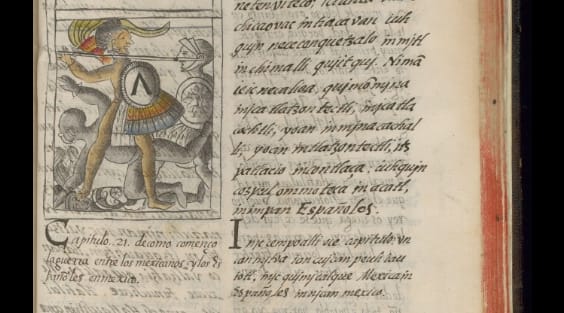
This singularity becomes more evident when considering the structure of the codex; Each page contains parallel columns in Nahuatl and Spanish, often accompanied by illustrations created by indigenous people. However, these columns do not always correspond exactly. The Spanish version is sometimes shorter, more concise, or more selective than the Nahuatl portion, especially in passages highlighting Spanish failure or brutality. This discrepancy is historically significant; it demonstrates that Book XII is not simply a translation of indigenous testimony into Spanish; it is a place where conflicting interpretations of the same events coexist (Nelson, 2020) (Favrot Peterson, et al., 2019).
The Nahuatl account should be read not as auxiliary or secondary evidence, but as a historical source for the defeated. Book Twelve is not just about the conquest; it also addresses how the conquest should be remembered. A further peculiarity lies in its hybrid form. It is contained within an encyclopedic manuscript, but it functions as a testimony. It was produced in part by the colonizers, but it preserves anti-colonial and anti-epic memories of the invasion. The Spanish translation is included, but it is inconsistent with the Nahuatl testimony, and it remains strong enough to undermine the coherence of the imperial narrative (León-Portilla, 1962) (Favrot Peterson, et al., 2019).
Indigenous Testimony and Spanish Historiography
The contrast between Book XII and Spanish historiography begins with the author’s position. Although Shagún’s intention was to preserve local culture, his Spanish translation of Book 12 emphasizes the friar’s culture and country of origin; the cultural substratum from which he was born is evident (Terraciano, 2014) (Nelson, 2020) (Lockhart, 1993). Indeed, the narratives of the Spanish conquest, which influenced the author, were written by men who led or participated in the invasion and therefore had strong reasons to justify their actions (Adorno, 1992) (Restall, 2021). Cortés wrote to the Spanish crown to present his exploits as politically legitimate and pleasing to God (Restall, 2021) (Cortés, 1971) (Adorno, 1992). Bernal Díaz, writing later, sought to defend the honor and merit of the conquistadors and to correct what he considered inadequate accounts (Restall, 2021) (Adorno, 1992) (Díaz del Castillo, 1956). In both cases, the narrative is deeply focused on affirming the Spanish-appropriate meaning of the events (Restall, 2021) (Adorno, 1992).
The Nahua account that forms Book XII comes from direct witnesses, or their descendants, of the conquest, experienced by the defeated, an exception to the saying that history is made by the victors (León-Portilla, 1962) (Favrot Peterson, et al., 2019). The purpose of the text is not to demand restitution, seek damages, or seek legal legitimacy, but to preserve memory. This difference in purpose has important historiographical consequences (Favrot Peterson, et al., 2019) (Townsend, 2019). Earlier Spanish texts emphasize initiative, courage, providence, and imperial order. Indigenous testimony emphasizes fear, massacre, desecration, confusion, and politics; in fact, the same events are narrated under different moral and emotional regimes (Nelson, 2020) (Gruzinski, 2018) (Favrot Peterson, et al., 2019).
Miguel León-Portilla’s work has been instrumental in making these indigenous testimonies better known to modern readers. In “The Broken Lances,” he narrates Nahua accounts that reveal how the conquest appeared from the perspective of the vanquished. Omens, lamentations, scenes of devastation, and massacres create a narrative very different from the Spanish self-celebration. What is important here is not only that the indigenous witnesses described different events, but that they attributed different meanings to the same events (León-Portilla, 1962).
This divergence has also been noted when comparing the different literary layers of Book XII. Indeed, the columns in Nahuatl and Spanish frequently diverge in tone and emphasis, and the illustrations add another layer of testimony that can intensify one or the other, discrediting the other (Terraciano, 2014) (Nelson, 2020) (Favrot Peterson, et al., 2019). The conquest appears not as a single, coherent, linear story between the two columns of the text, but as a battlefield where two different narratives vie for moral primacy. Reading Book XII only in its Spanish translation would flatten this plurality and perpetuate colonial hierarchy within the archive (Lockhart, 1993) (Terraciano, 2014).
Spanish historiography also often claims the authority of eyewitness testimony, but Book XII does so as well (Terraciano, 2014) (Adorno, 1992). However, the difference lies in the fact that Spanish eyewitness testimony is linked to the conquest as a chivalrous and epic act (Adorno, 1992) (Restall, 2021); in fact, the primary sources are those of those who carried out the conquest; whereas Nahua eyewitness testimony is linked to the conquest as an experience of destruction and social collapse (Favrot Peterson, et al., 2019) (León-Portilla, 1962) (Lee, 2003). From this, it can be argued that, in the writing of the two narratives, the conqueror claims the authority of action, while the conquered claims the authority of suffering and survival (Restall, 2021) (Townsend, 2019) (Gruzinski, 2018). This distinction is fundamental to the argument of the paper, because it demonstrates that the opposition between indigenous testimony and Spanish historiography is not simply a question of perspective, but of different ways of experiencing it. At the core is what counts as history, who is authorized to tell it, and which experiences become central to the narrative (Lee, 2003) (Adorno, 1992).
Narrative Differences and the Meaning of Conquest
One of the most striking features of Book XII concerns the framing of the conquest itself. In many Nahua accounts, the narrative does not begin with the Spanish action, but with omens and signs interpreted as bad omens (León-Portilla, 1962) (Favrot Peterson, et al., 2019) (Restall, 2021). Consequently, this opening gives events a cosmological dimension, within the cyclical cosmology typical of the Mesoamerican populations (Todorov, 1992). The conquest appears as something that disrupts an existing world and is foretold by signs of disorder, anxiety, and divine warnings (Restall, 2021) (Gruzinski, 2018). The narrative is therefore placed within a framework of historical consciousness different from that of European military chronicles (Favrot Peterson, et al., 2019) (Todorov, 1992).
Spanish historiography generally avoids this cosmological register; in fact, Cortés and Bernal Díaz present the conquest through the logic of a typical and legitimate military campaign, therefore of conflict and victory. The progression of the story is more linear (Restall, 2021) (Adorno, 1992)
(Todorov, 1992) and their causal language is more secularized yet still reflects the logic of succession of events typical of Christian providence, while maintaining the political perspective centered on the Spanish military initiative (Restall, 2021). Book XII, by contrast, places emotional intensity and symbolic interpretation at the center of the story, making the narrative less historiographical (Todorov, 1992) (Gruzinski, 2018). Rather, it reveals that historical narrative can be organized through cultural categories different from those typical of European historiography (Townsend, 2019) (Gruzinski, 2018) (Todorov, 1992).
In Spanish accounts, violence is often rationalized as military necessity; whereas, in indigenous accounts, it is frequently described from the perspective of those who suffered it, and its consequences are placed at the center of the narrative (Restall, 2021) (Lee, 2003) (León-Portilla, 1962). It is evident when reading the two columns of the codex how the Spanish text compresses or attenuates these moments, while the narratives in Nahuatl and the illustrations show the violence in a more crude and direct manner. This is of great importance because it demonstrates how colonial mediation reshaped the historical record without completely suppressing indigenous memory (Nelson, 2020) (Favrot Peterson, et al., 2019).
The example of the massacre during the Toxcatl festival is emblematic. In the indigenous column, the massacre appears as an act of betrayal and a moral turning point and revelation that unmasks Spanish brutality. It is not represented as an accidental clash, much less a military clash between the two-armed forces, but as an atrocity with profound political and symbolic consequences (Favrot Peterson, et al., 2019). These episodes dismantle the heroic image cultivated by Spanish historiography of conquistadors guided by providence and a spirit of adventure (Restall, 2021). They demonstrate that the conquest was not experienced as the orderly transfer of sovereignty, celebrated in imperial narratives, but rather as an unpredictable and devastating invasion driven solely by the goal of expropriation and the obsessive search for gold (Terraciano, 2014) (Lee, 2003) (Nelson, 2020) (León-Portilla, 1962).
Similarly, events like the so-called Noche Triste take on different meanings depending on the column read; what Spanish memory frames as a night of pain for the invaders can also be understood, from the Nahua perspective, as a moment of indigenous resistance and a temporary reversal of trends. Analyzing these discrepancies between the columns is a methodological issue. The comparison does not simply identify the prejudices of both sides but reveals how the same episode takes on a different historical significance when narrated from opposing positions within a conflict (Favrot Peterson, et al., 2019) (Restall, 2021) (Lee, 2003) (Nelson, 2020).
Indigenous Agency and the Problem of Spanish Triumph
A central theme in modern historiography is the inadequacy of the traditional narrative that attributes the fall of Tenochtitlan exclusively to Spanish superiority. This myth has long been questioned from various perspectives, which has helped us better understand why Book XII is historiographically important (Restall, 2021) (Townsend, 2019) (Hassig, 1994)
It should be emphasized that the conquest cannot be understood without understanding the indigenous military structures, political rivalries, alliance systems within the local population, and the ethnic dynamics that pre-existed the arrival of the Spanish empire. The Spanish did not conquer Mesoamerica alone; in fact, they inserted themselves into the conflicts left open by the recent Mexica conquest between the various populations, exploiting pre-existing indigenous hostility and conflicts both within and outside Moctezuma’s empire, immediately securing the support of groups hostile to the central power in Tenochtitlan. This does not diminish Spanish violence, but it radically alters the interpretative framework. The conquest becomes a process shaped both by indigenous choices and mistakes and by Spanish ambitions. The conquest could be considered halfway between a civil war and a revolt against a central power that was despotic and cruel toward the conquered (Todorov, 1992) (Townsend, 2019) (León-Portilla, 1962) (Restall, 2021) (Hassig, 1994).
By analyzing the literature, we can identify “myths” that shaped the history of the conquests, including the myth of the handful of Spaniards, the passivity of the indigenous people, and the inevitable European superiority. This work brings Restall to the fore, unmasks these myths, and helps explain the tremendous importance of this book and the marginalization to which it was long consigned (Restall, 2021) (Terraciano, 2014). It contradicted too much the assumptions that supported Spanish epic historiography, and indigenous testimony emphasizes political complexity, local agency, and the decisive role of non-Spanish actors—issues that have long been relegated to the shadows of history (Restall, 2021) (Townsend, 2019) (Lee, 2003) (Favrot Peterson, et al., 2019) Starting from indigenous-language sources helps reconstruct the history of the Mexica empire, and more generally of Nahua culture (Townsend, 2019), and has thus been able to demonstrate that native actors did not simply react to European intrusion but negotiated and attempted to develop military strategies and resist within their own indigenous experience (Townsend, 2019) (Restall, 2021). This perspective closely aligns with the narrative of Book XII, which does not portray the Nahua as passive victims of an unstoppable process of civilization. On the contrary, it presents them as actors (Favrot Peterson, et al., 2019) (Lee, 2003) confronted with an unprecedented and devastating situation, culminating in the clash between two different civilizations and the disappearance of the loser (Townsend, 2019) (Gruzinski, 2018).
All the above is crucial to explaining the peculiarity of this conquest because Spanish historiography often interprets indigenous aid as evidence of Spanish greatness and the ultimate success of the conquest, making the Nahua allies appear dependent and grateful to the Spanish or auxiliaries to the Spanish “handful” (Restall, 2021) (Hassig, 1994). Book XII and modern research based on indigenous testimonies reveal a different picture, in which indigenous groups were not simply absorbed into a Spanish campaign; in fact, they pursued their own interests, interpreted the political crisis through their own mental frameworks, and contributed decisively to the outcome (Restall, 2021) (Townsend, 2019). Indeed, not all indigenous actors shared the same goals or experiences. On the contrary, it means that the conquest was internally fragmented and incoherent. and precisely for this reason the narrative of a solely Spanish triumph is insufficient (Restall, 2021) (Lee, 2003).
Scale, Connection, Comparison
Olstein’s in-depth methodological reflections offer an effective framework for analyzing Book XII beyond the confines of national or imperial historiography. Indeed, his categories of scale, connection, and comparison allow us to understand the conquest both as a local event and as a component of global change (Olstein, 2015). This is particularly useful for a text like Book XII, which is rooted in the specific experience of Tenochtitlán but also addresses broader issues such as imperialism, expropriation, translation, violence, and historical representation (Favrot Peterson, et al., 2019) (León-Portilla, 1962) (Nelson, 2020) (Lee, 2003) (Gruzinski, 2018).
Book XII records the experiences of individuals and communities within the besieged and conquered city. It transmits the reality experienced by the war from below: fear, hunger, the breakdown of rituals, and the disintegration of the social order (Terraciano, 2014) (León-Portilla, 1962). At the regional level, the narrative is set within a Mesoamerican civilization structured by imperial and subjugated relationships, rife with rival political entities and long-standing military tensions (Townsend, 2019) (Restall, 2021). On a global scale, the conquest is part of a broader process of imperial expansion, Atlantic navigation and discovery, and the creation of new knowledge models under colonial rule, fitting into the context of the first empire on which the sun never set and the subsequent birth of the first wave of globalization ( (Olstein, 2015) (Gruzinski, 2018) (Marcocci, 2020). Therefore, reading Book XII from a global perspective does not mean dissolving the specificity of local experience, but rather means understanding how local testimony fits into and enriches a transformation of global-historical significance (Favrot Peterson, et al., 2019) (Gruzinski, 2018) (Olstein, 2015).
Spanish historiography often emphasizes the connection between the conquest and imperial destiny, linking Mesoamerica to Spain and placing it within the context of the Christian mission of evangelization (Restall, 2021) (Marcocci, 2020). This book reveals a more complex network of connections, between the various agents of this history, both indigenous and Spanish (Restall, 2021) (Hassig, 1994), between the war of conquest or defense and the ritual and religious life of the Nahua culture (Favrot Peterson, et al., 2019) (Townsend, 2019), between the memory of expropriation and destruction and between an imperial system seeking political legitimacy in the Christianizing mission, and the connection between the siege and destruction of the world’s most populous city (Lee, 2003) (León-Portilla, 1962) and the broader collapse of a political, cosmological, and social order. This idea is reinforced by modern historiography, which shows how the conquest depended on indigenous alliances and rivalries, and not simply on a Spanish initiative (Favrot Peterson, et al., 2019) (Gruzinski, 2018).
Comparison, however, is central to this paper; it is the necessary condition for grasping the uniqueness of Book XII. Only by comparing it with Spanish historiography can one understand how radically different its temporality, its moral structure, and its portrayal of the actors are, as is everything else written so far (Lee, 2003) (Townsend, 2019) (Todorov, 1992) (Favrot Peterson, et al., 2019). Comparison reveals the conquest not as a coherent event narrated differently only in subtle nuances and details, but as a controversial event whose meaning changes depending on the point of view, and changes radically, starting with who contributed most to the conquest (Restall, 2021). In this sense, Book XII not only enriches the historiography of the conquest, but radically changes it (Lee, 2003) (Restall, 2021) (Nelson, 2020).
A purely Spanish history of the conquest tends to privilege macro-level expansion and the logic of European imperial states (Todorov, 1992) (Restall, 2021) (Gruzinski, 2018); Meanwhile, a purely local narrative risks losing sight of the broader transformations triggered by the conquest and the events that preceded Cortes’s arrival (Townsend, 2019) (Olstein, 2015). Comparing Book XII with Spanish historiography resists both reductions. Indeed, it shows how a single local catastrophe can reveal the victors’ logical inconsistencies (Lee, 2003) (Favrot Peterson, et al., 2019) (Nelson, 2020) and how global processes are reflected through specific cultural experiences (Todorov, 1992) (Favrot Peterson, et al., 2019); consequently, its uniqueness is inseparable from Olstein’s methodological strength (Marcocci, 2020) (Olstein, 2015).
Question of the Other
The conquest can be analyzed as a problem of otherness, providing another fundamental key to understanding the difference between indigenous testimony and Spanish historiography. Indeed, the conquest of America was not only a military event, but also an encounter shaped by asymmetrical interpretations of the Other (Restall, 2021) (Todorov, 1992). The conquerors, seeking to know, classify, and dominate, misunderstood the symbolic worlds they encountered (Todorov, 1992) (Marcocci, 2020). This perspective is particularly relevant to Book XII, since the right-hand column records not only the violence suffered, but also the bewilderment, uncertainty, and interpretative difficulties of a people faced with a catastrophic event in all their typical metrics (Todorov, 1992)
(Favrot Peterson, et al., 2019) (Nelson, 2020) (Gruzinski, 2018)
Spanish historiography often represents indigenous actors through categories that reduce otherness to inferiority; They are portrayed as barbarians, idolaters, infantile, or politically incompetent, thus reinforcing the legitimacy of the conquest and the civilizing logic (Todorov, 1992) (Gruzinski, 2018). Even when admiration is expressed, it often serves to magnify the Spanish victory (Restall, 2021) (Gruzinski, 2018); in this sense, the literature on the conquest draws on the broader epistemology of colonial rule (Marcocci, 2020) (Gruzinski, 2018).
This book disrupts this pattern, not presenting the Spanish as superior civilizations bringing order to chaos (Townsend, 2019) (Restall, 2021) (Lee, 2003); rather, they are presented as dangerous intruders whose actions are difficult to interpret and whose violence often exceeds recognizable norms (Todorov, 1992) (Favrot Peterson, et al., 2019) (Lee, 2003) (Gruzinski, 2018)). It brings indigenous perception back to the center, forcing us to confront the conquest not only as a geopolitical fact, but as a crisis of mutual intelligibility (Townsend, 2019) (Todorov, 1992) (Restall, 2021) (Gruzinski, 2018).
If the conquest is interpreted only through the discourse of the conquerors, then otherness becomes an object to be described and controlled (Gruzinski, 2018) (Restall, 2021) (Todorov, 1992). From a serious reading of this book, it becomes clear that otherness becomes mutual (Todorov, 1992) (Olstein, 2015) (Favrot Peterson, et al., 2019), and even the Spanish appear incomprehensible, excessive, and morally compromised (Todorov, 1992). Thus, historical reconstruction is no longer organized exclusively around European self-consciousness (Townsend, 2019) (Restall, 2021) (Gruzinski, 2018).
This also applies to the figure of Moctezuma; the Spanish often portrayed him as weak, indecisive, or fatally mistaken in his understanding of Cortés (Townsend, 2019) (Restall, 2021) (Todorov, 1992). Interpretations based on the narratives of indigenous peoples tend to address a more complex situation in which Moctezuma faced a crisis that could not be reduced to simple naivety (Restall, 2021) (Townsend, 2019). It’s not a question of whether one image can be simply replaced by another, but rather that Spanish accounts were never neutral descriptions; they were attempts in the struggle to define the meaning of the conquest (Restall, 2021) (Townsend, 2019).
Historical Consciousness
Europeans in the early days of globalization sought to rewrite world history to encompass the spaces and peoples they encountered through conquest; these histories were obviously shaped by the mental and epistemological structures typical of empires, by Christian universalism, and by the classificatory ambitions of Renaissance science (Favrot Peterson, et al., 2019) (Gruzinski, 2018) (Marcocci, 2020)
This work lies on the margins of this process; despite being part of the Spanish colonial archive, it was not incorporated into modern world historiography; indeed, it was banned. Whether thanks or not to the conquerors themselves, the knowledge they contained was thus able to resist complete assimilation, preserving it within the categorical reduction of the Renaissance (Favrot Peterson, et al., 2019). It is thus possible to demonstrate that European expansion did not simply erase other ways of relating to time and history, but rather that colonial modernity, through the contact of conquest, implied the overlap, conflict, and hybridization of different temporal regimes and epistemological systems (Gruzinski, 2018) (Favrot Peterson, et al., 2019).
This conflict is easily traced in this volume, focusing on the attention to omens, the emphasis on rituals and their destruction, the narrative and memory of suffering; all of this suggests a mode of historical understanding in which the conquest is not simply a succession of events, but the collapse of their world (Favrot Peterson, et al., 2019) (Gruzinski, 2018) (León-Portilla, 1962). This perspective is not “prehistoric” or irrational, but rather a coherent historical consciousness, which connects the political catastrophe to the cosmological epistemology typical of these peoples. This is a crucial point, because Spanish historiography has often denied indigenous historicity, treating native actors as peoples without a history of their own until the arrival of Europeans. This is refuted in the twelfth book, demonstrating that Nahua intellectuals not only had a history, but also transmitted it in ways that preserved their own categories of meaning (Gruzinski, 2018) (Townsend, 2019) (Favrot Peterson, et al., 2019). A further peculiarity of this book is its embodiment of a nonEuropean mode of narrating a rupture that had world-historical resonance. This book can be seen within the context of emerging global historiography and considered an example of plurality and conflict within the category (Favrot Peterson, et al., 2019) (Marcocci, 2020) (Olstein, 2015).
The issue is not simply that indigenous testimony adds missing information from Spanish accounts, but that it changes the very form of historical explanation; from this book the conquest can no longer be understood exclusively through the European epistemology of the time but must also be understood through the indigenous historical consciousness (Townsend, 2019) (Favrot Peterson, et al., 2019) (Lee, 2003).
The Peculiarity of a Peculiar Conquest
The title of this paper highlights two interconnected peculiarities. The first concerns the book itself, which is unique because it is the only historical source present in the Florentine Codex and because it preserves indigenous testimonies within a colonial manuscript (Favrot Peterson, et al., 2019). The second concerns the conquest itself and the testimonies of it in Spanish historiography. The conquest was unique not because it was unique in the abstract, but because it condensed an extraordinary range of phenomena, from military invasion to intercultural encounters and epidemic devastation, from inter-civilizational and indigenous alliances to imperial expansion and the translation of historical memory and epistemological struggle (Gruzinski, 2018) (Favrot Peterson, et al., 2019)
(Restall, 2021) (Marcocci, 2020)
Spanish historiography has often reduced this complexity to a coherent narrative of providential victory, but it has been shown that the Book of the Conquest resists this reduction; Indeed, it has revealed fragmentation where the triumphalist narrative seeks unity (Restall, 2021) (Lee, 2003), showcased indigenous agency where imperial discourse seeks Spanish centrality, revealed catastrophe where colonial memory seeks legitimacy, and highlighted that the conquest was never simply a Spanish act imposed on passive populations, but rather a profoundly intricate process in which multiple actors, asymmetries of power, and conflicting interpretations interacted (Favrot Peterson, et al., 2019) (Lee, 2003) (Nelson, 2020).
The value of this book lies not simply as a documentary source, but also in its historiographical and theoretical value. It has highlighted the political dynamics of the narrative, the asymmetries of colonial translation, and the inadequacy of any account that considers the conquest as a purely European event. Through comparison with Spanish historiography, its uniqueness emerges as a challenge to the very systems in which the conquest has been remembered (Favrot Peterson, et al., 2019) (Restall, 2021).Finally, it should be emphasized that this volume suggests that local testimony is not the opposite of global history, but one of its necessary foundations; with it, it can begin to record the plurality of historical consciousness that shaped the world of the early modern age (Gruzinski, 2018) (Olstein, 2015) (Marcocci, 2020).
Conclusion
Within the twelve-book encyclopedia, it stands out as the only historical narrative, and within the literature on the conquest, it stands out because it gives voice to the testimony of the Nahua and preserves their memory of the conquest, irreducible to Spanish triumphalism. The account of the conquest and the indigenous reaction reveal a radically different understanding of what happened between 1519 and 1521.
Comparison with Spanish historiography shows that the difference is not limited to emphasis or style but concerns the very meaning of the story. Spanish narratives emphasize the initiative and legitimacy of heroic action, all willed and protected by providence; Book XII emphasizes the suffering and memory of a defeated people. Spanish texts present the conquest as the expansion of the empire, while Book XII presents it as the destruction of a world and is understood, rather than misunderstood, through the cosmological interpretations of Nahua culture.
The paper demonstrated that Book XII is particularly valuable because it connects local experience to global transformation without dissolving the specificity of the Nahua testimony. It analyzed how the conquest unleashed a crisis of otherness and interpretation, making it possible to see Book XII as part of a broader struggle over how world history should have been written. The conquest itself appears not as a unilateral European imposition, but as a complex process shaped by indigenous alliances, cultural asymmetries, and contested memories.
The uniqueness of Book XII, therefore, lies in the fact that it preserves an indigenous perspective within a colonial archive and has transformed its very roots. It recounts a unique conquest because it was never simply a military episode or a chapter in imperial expansion; it was an event of narrative violence, epistemological conflict, and historical plurality. Reading Book XII today means recognizing that an adequate history of the conquest cannot be written without the voices that Spanish historiography sought to erase.
Bibliography
Adorno Rolena The Discursive Encounter of Spain and America: The Authority of
Eyewitness Testimony in the Writing of History [Journal] // The William and Mary
Quarterly. – Williamsburg, VA : Omohundro Institute of Early American History & Culture, 1992. – 2 : Vol. 49. – pp. 210-228.
Cortés Hernán Letters from Mexico [Book] / translation Dermer Pagden Anthony Robin. – New York City, Ny : Grossman Publishers, 1971.
Díaz del Castillo Bernal The discovery and conquest of Mexico [Book] / trans.
Leonard Irving Albert. – New York City, NY : Farrar, Straus, and Cudahy, 1956.
Favrot Peterson Jeanette and Terraciano Kevin The FLORENTINE CODEX, An Encyclopedia of the Nahua World in Sixteenth- Century Mexico [Book]. – Austin :
University of Texas Press, 2019.
Gruzinski Serge La macchina del tempo. Quando l’Europa ha iniziato a scrivere la storia del mondo [Book] / translation Benzoni Maria Matilde. – Milan : Raffaello Cortina Editore, 2018.
Hassig Ross Mexico and the Spanish Conquest [Book]. – London : Longman, 1994.
Lee Jong-Soo Indigenous Accounts of the Conquest of Mexico: reevaluating sources and current studies [Journal] // Asian Journal of Latinamerican Studies. – Seul :
Korean Latin American Society, 2003. – 1 : Vol. 16. – pp. 179-196.
León-Portilla Miguel The Broken Spears: The Aztec Account of the Conquest of Mexico [Book] / trans. Kemp Lysander. – Boston, MA : Beacon Press, 1962.
Lockhart James We People Here: Nahuatl Accounts of The Conquest of Mexico [Book]. – Berkeley, CA : University of California Press, 1993.
Marcocci Giuseppe The Globe on Paper: Writing Histories of the World [Book]. – Oxford : Oxford University Press, 2020.
Nelson Erika Bernardino de Sahagún and collaborators, Florentine Codex [Online] // Khan Academy. – 2020. – https://www.khanacademy.org/humanities/art-americas/newspain/viceroyalty-new-spain/a/bernardino-de-sahagn-and-collaborators-florentinecodex.
Olstein Diego Thinking History Globally [Book]. – London : Palgrave Macmillan, 2015.
Restall Matthew Seven Myths of the Spanish Conquest. Updated Edition [Book]. – Oxford : Oxford University Press, 2021.
Terraciano Kevin Narratives of the Conquest of Mexico from Tlatelolco [Journal] //
Estud. cult. náhuatl. – Mexico City, DF : Universidad Nacional Autónoma de México, 2014. – 1 : Vol. 47. – pp. 211-235.
Todorov Tzvetan The Conquest of America: The Question of the Other [Book]. – New York City, NY : Harper Perennial, 1992.
Townsend Camilla Fifth Sun: A New History of the Aztecs [Book]. – Oxford : Oxford University Press, 2019.


Rispondi